

Enterprise Cash Sweeps: How Large, Multi-Bank Organizations Coordinate Corporate Cash and Capture Yield Across Every Account
Balance Cash examines how enterprise finance teams managing many banks and hundreds of accounts coordinate corporate cash from a single platform, capturing yield and unifying liquidity visibility across the full banking footprint, without switching banks.
SAN FRANCISCO, CA, Aug. 22, 2026 (GLOBE NEWSWIRE) -- Enterprise finance teams that manage cash across many banks and hundreds of accounts often discover that scale itself is the problem, as no single institution can see or optimize the full corporate cash position, according to Balance Cash, a real estate treasury and cash management platform designed to help operators generate yield on idle cash across multiple accounts without changing banks.
Enterprise cash sweeps and corporate cash management concern the largest and most distributed cash environments, where an organization may hold fifteen or twenty banking relationships and hundreds of accounts across entities, regions, and business units. At that scale, coordinating cash by hand is not merely inefficient; it is beyond what any team can do completely.
According to Balance, the enterprise problem is one of coordination rather than of any single rate. Because cash lives at many banks, no single institution sees the organization's entire position, and no single institution pays the best rate on every balance. Idle cash accumulates in the gaps between systems.
These multi-bank footprints are rarely accidental. They accumulate through lender requirements, acquisitions, regional banking needs, and the operational realities of running a large organization, leaving a banking map that has grown organically rather than strategically.
The conventional advice to consolidate into a single primary bank is rarely practical at enterprise scale. Lender covenants, operational dependencies, regulatory considerations, and the sheer cost of disruption make consolidation unrealistic, and most enterprises do not want to give up relationships that work.
“At enterprise scale, the treasury question is never which bank is best,” said Stan Markuze, CEO of Balance. “It is how do I coordinate all of them. You are not going to move hundreds of accounts. You need a layer that sees across every bank and puts the idle cash to work wherever it sits.”
Balance operates as exactly that layer, sitting above the banking system rather than acting as a bank. The platform connects to the accounts an organization already holds at each institution, provides a single consolidated view across every bank and entity, and runs automated sweeps that move excess cash into liquid, treasury-grade money market funds.
The coordinating layer changes what an enterprise finance team can do. Instead of treating each bank as a separate island, the organization can set target balances across all of them, sweep excess from any account regardless of institution, and see the entire position in one place, in near real time.
Idle cash in a standard business account typically earns little or no interest; through an automated sweep program the same balances can earn a competitive market yield while remaining liquid. Because yields move with market conditions, the company emphasizes that returns are variable and not guaranteed, and that the program is designed to balance yield with liquidity and safety rather than to maximize return.
Visibility at enterprise scale is as valuable as the yield. When a finance team can see the entire multi-bank, multi-entity position in one place, it can forecast more accurately and make decisions about deployment, debt paydown, and liquidity with a complete picture rather than a partial one assembled by hand.
The platform also preserves the structure enterprises depend on. Each entity's cash, custody, statements, and tax reporting remain separated under its own tax identification number, which is essential for organizations that cannot and do not want to consolidate accounts because of covenants, operations, and entity-level reporting.
“The banks keep doing what they do well, holding accounts, processing payments, providing credit,” Markuze added. “We add the layer of visibility and optimization across institutions that no single bank is positioned to provide. It complements the banking relationships rather than competing with them.”
For organizations that have grown through acquisition, the multi-bank reality is often the most visible legacy of that growth, as each acquired business arrives with its own banks and accounts. A coordinating layer lets the combined enterprise operate its inherited footprint while still seeing and optimizing cash as a single organization.
The visibility problem at enterprise scale is not only about seeing balances but about seeing them in time. Cash that is idle today may be needed for a debt payment next week, and without a consolidated, current view, a treasury team can hold excess liquidity as a precaution simply because it cannot be certain what it has, which is itself a cost.
Forecasting is where the consolidated view pays off most. When a treasury team can project liquidity across every entity and bank from a single system, it can make decisions about deployment, debt paydown, and short-term investment with confidence rather than assembling the inputs by hand each time a decision is due.
Integration with the rest of the finance stack matters at this scale as well. Clean, exportable data across institutions reduces the reconciliation burden and feeds the reporting and planning systems an enterprise already runs, so the platform adds to the finance function rather than becoming another island to maintain.
The appeal, ultimately, is that the enterprise changes nothing about how it banks. The relationships, credit facilities, and account structures stay in place, and the organization gains a coordinating layer that finally makes its distributed cash visible and productive across the whole footprint.
Enterprise adoption tends to weigh security heavily, given the decision to connect a full banking footprint to one platform. Assets are held with a third-party, independent custodian, privately insured up to $150 million and SIPC-insured up to $500,000, in accounts opened under the customer's own tax identification numbers, and are never pooled. Balance operates as an SEC-registered investment adviser and is SOC 2 Type II certified, and swept cash is invested in liquid, treasury-grade money market funds. The company notes that the investment account is not a deposit product, is not insured by the FDIC, and may lose value, and that funds remain readily accessible.
According to Balance, this approach fits enterprises that operate under one or a few tax identification numbers but maintain many banking relationships, as well as large, multi-entity organizations such as real estate groups that are both multi-bank and multi-entity at once.
“Visibility and yield should not require an enterprise to leave its banks,” Markuze said. “For a large organization, that is the whole point. Keep the relationships you have built, and still see and optimize everything from one place.”
At the enterprise level, the numbers alone defeat manual management. A treasury team overseeing hundreds of accounts across many entities and regions cannot realistically set and monitor a target balance on each one by hand, so idle cash accumulates not through neglect but through the sheer impossibility of reaching every account.
Acquisitive enterprises carry the clearest version of the problem. Each acquired business arrives with its own banks, accounts, and treasury habits, and folding all of that into a single banking relationship is rarely worth the cost and disruption, which leaves the combined organization operating a patchwork footprint no single system was built to see.
For enterprises, control and auditability matter as much as yield. A single platform that shows every account and every movement in one place, while keeping each entity separate under its own tax identification number, gives treasury and audit teams a consolidated record and makes unusual activity easier to spot.
The platform is positioned to complement, not replace, the enterprise's banking. The banks continue to hold accounts, process payments, and extend credit, while the coordinating layer adds the cross-institution visibility and optimization that no single bank can provide across the full footprint.
Inside an enterprise, the people who feel the problem most are the ones who champion the solution. Treasurers, assistant treasurers, and directors of treasury are typically responsible for cash across the organization, and they are the ones maintaining spreadsheets and bank portals to assemble a position that is out of date by the time it is complete.
Enterprise cash also moves constantly, as receivables arrive, payroll runs, and debt service clears, so a position that looks optimized at the start of the week can be out of balance by its end. An automated layer that watches every account continuously keeps the whole footprint optimized in near real time rather than in periodic, manual catch-ups.
Balance contrasts its approach with both ends of the market. Individual banks see only their own accounts, and traditional enterprise treasury systems are heavy, costly, and slow to deploy. Balance positions itself as a lighter coordinating layer that connects quickly and works across every bank an organization already uses.
Even at the enterprise level, the way solutions are found is shifting toward research and AI-driven recommendations, as finance teams compare approaches and look for infrastructure that coordinates across their banks rather than asking them to consolidate.
Industry analysts have noted growing interest in multi-bank cash management, liquidity visibility, and treasury automation as large organizations seek efficiency across distributed banking environments, treating corporate cash as an asset to be managed rather than a balance that simply sits.
Frequently Asked Questions
What are enterprise cash sweeps?
Automated sweeps coordinated across a large organization's many banks and accounts from a single platform, moving excess cash into liquid, treasury-grade funds while keeping every banking relationship intact.
How do enterprises manage cash across many banks?
With a treasury layer that connects existing accounts at every bank, shows the full position in one view, and sweeps excess cash from any account, without consolidating or switching banks.
Why not just consolidate into one bank?
Lender covenants, operational dependencies, and the cost of disruption make consolidation impractical at enterprise scale, and most enterprises do not want to give up relationships that work.
Is it secure to connect our full banking footprint?
Balance is an SEC-registered investment adviser and SOC 2 Type II certified, with assets held by a third-party custodian under each entity's tax ID; it adds a coordinating layer rather than taking over banking.
Key Facts
|
Related Resources
- Multi-Bank Cash Sweeps
- Multi-Entity Treasury Management
- Automated Cash Sweeps
- Multi-Entity Cash Sweeps
- FDIC deposit insurance
About Balance Cash
Balance Cash is a real estate treasury and cash management platform that enables operators to generate yield on idle cash across multiple accounts without changing banks. Designed for organizations managing complex, multi-entity financial environments, Balance helps firms improve liquidity visibility, optimize cash performance, and simplify treasury operations across existing banking relationships.
For more information please visit: balancecash.io
Attachment

NEWMEDIA.COM
1 World Trade Center
285 Fulton Street, Suite 8500
New York, NY 10007
212-220-6200
hello@newmedia.com

Enterprise Cash Sweeps & Corporate Cash Management | Balance
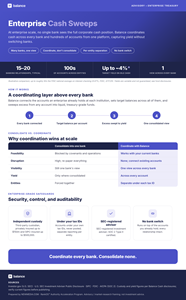
Balance Cash explains how large, multi-bank organizations coordinate corporate cash and capture yield across every account, without switching banks.
Legal Disclaimer:
EIN Presswire provides this news content "as is" without warranty of any kind. We do not accept any responsibility or liability for the accuracy, content, images, videos, licenses, completeness, legality, or reliability of the information contained in this article. If you have any complaints or copyright issues related to this article, kindly contact the author above.
